



The Son of a Migrant from Syria by Banksy
From A$30.00
- All Australian orders for Art are printed and finished in Noosa and Perth, Australia (*International orders are printed overseas)
- We use 100% Cotton, textured canvas NOT the cheaper plastic looking, Poly-Cotton
- Free image manipulation such as removing red-eye, straightening horizons and lightening the image if needed
- Art is delivered ready to hang on the wall, straight to your door
- Carefully bubble wrapped and boxed to prevent damage in transit
- Free choice of 6 wrapping types
- Every canvas print is stretched on a thick, 1.5” quality kiln-dried pine wood stretcher frame
- Protected with invisible spray UV laminate against fading in the harsh Australian climate, our art shouldn’t fade for up to 70 years!
The Blue Horizon Difference

Related products
-

Banksy Robot Barcode
This product has multiple variants. The options may be chosen on the product page -
Cat in a Box
This product has multiple variants. The options may be chosen on the product page -
Banksy Trolley Hunters
This product has multiple variants. The options may be chosen on the product page -
Banksy Love New York
This product has multiple variants. The options may be chosen on the product page


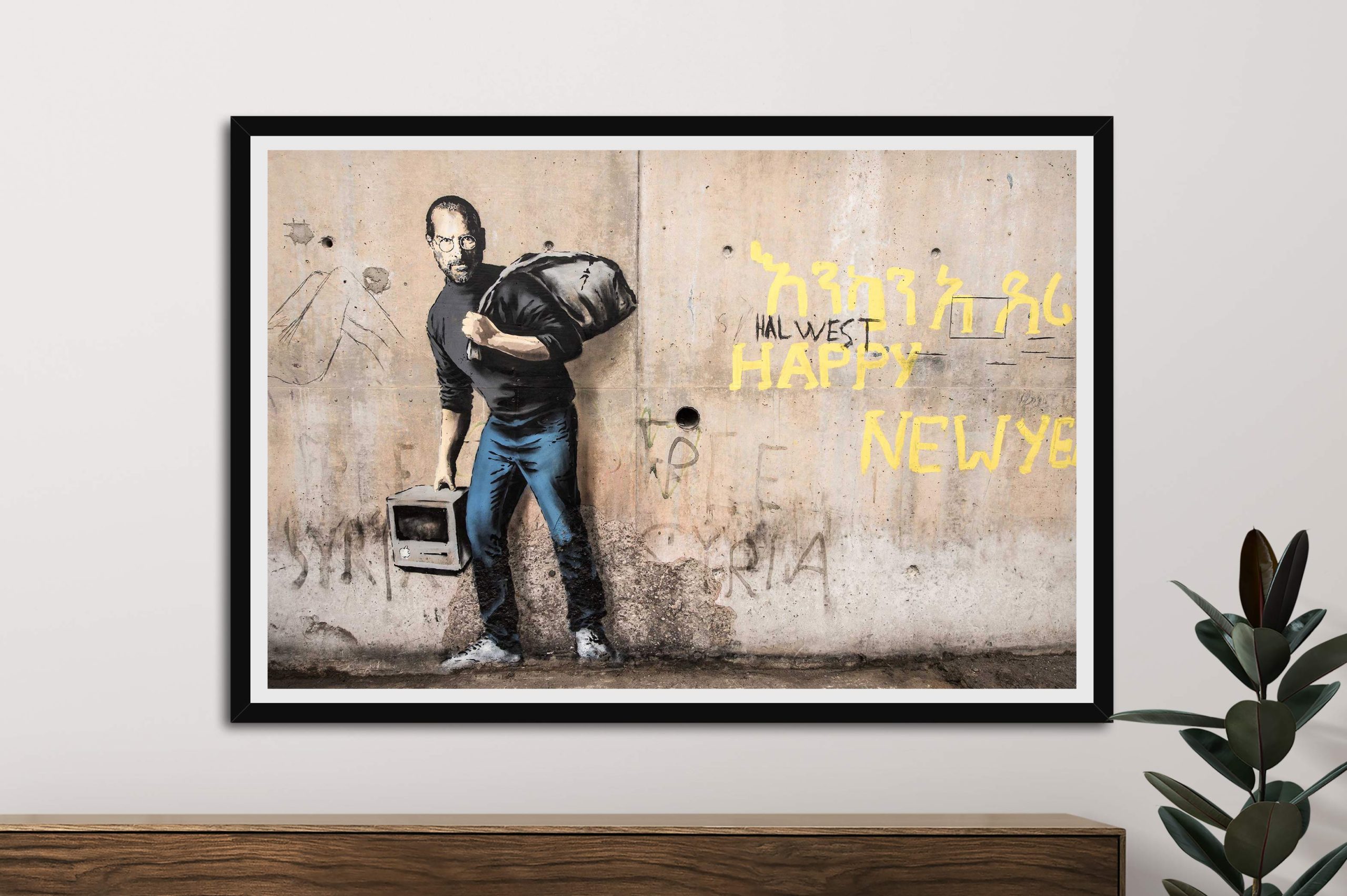
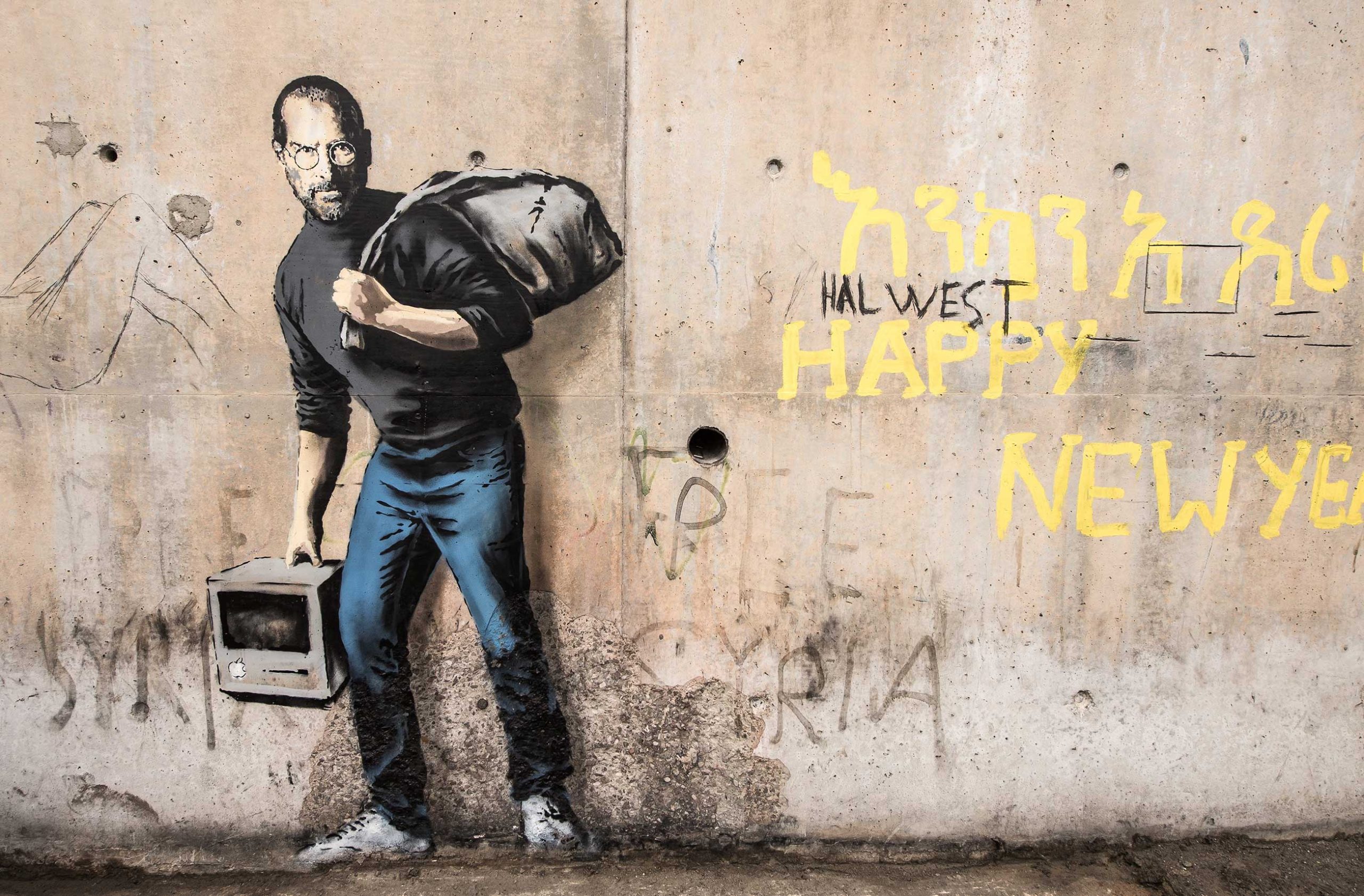
Banksy’s The Son of a Migrant from Syria is one of the most evocative works of art to emerge in recent years. Depicting Steve Jobs as a migrant, Banksy combines the icon of global innovation with the often-overlooked reality of displacement. The image of Jobs, carrying a sack on his shoulder and an old Apple computer, invites viewers to question preconceived notions about refugees. By choosing a figure as recognisable as Jobs, Banksy reframes the conversation about migration, forcing us to confront the untapped potential that lies within these communities.
The mural’s simplicity makes its message all the more powerful. Jobs, rendered in Banksy’s signature stencil style, appears unadorned and vulnerable. The sack he carries is a symbol of the burdens migrants often shoulder—both literally and metaphorically—while the Apple computer is a reminder of the transformative possibilities that arise when those burdens are eased. This contrast between vulnerability and potential lies at the heart of the artwork’s impact, making it a potent statement about humanity’s shared responsibility.
What makes this piece so compelling is its setting. Painted on a wall in the Calais refugee camp, the mural speaks directly to its environment. The stark reality of “The Jungle,” as the camp was often called, becomes part of the artwork’s narrative. This is not a piece designed for the sterile walls of a gallery—it was created for the streets, for those living the reality of displacement, and for the global audience watching from a distance. It reminds us that art doesn’t just exist to decorate; it exists to provoke, to question, and to inspire change.
Banksy’s choice of Steve Jobs is deliberate and layered with meaning. As the son of a Syrian migrant, Jobs’ story challenges stereotypes about refugees. Here is a man whose family’s history of displacement didn’t hinder his potential but instead laid the groundwork for extraordinary success. Banksy uses Jobs as a symbol of what the world stands to lose when it views migrants solely as a crisis, rather than as individuals with aspirations, talents, and the capacity to contribute meaningfully.
The placement of this piece in the Calais camp also underlines Banksy’s belief in making art accessible. By situating it in a public space, the mural doesn’t just speak to a privileged audience—it speaks to everyone, from the residents of the camp to the passers-by who encounter it. It’s a reminder that art isn’t limited to museums or elite institutions. Instead, it belongs on the streets, where its message can resonate with the widest possible audience.
Years later, The Son of a Migrant from Syria remains one of Banksy’s most poignant works. Its relevance hasn’t faded; if anything, it has grown as migration continues to be a defining issue of our time. For Blue Horizon Prints, offering this piece isn’t just about selling art—it’s about sharing a message. It’s about bringing a conversation into people’s homes and inviting them to reflect on the world around them. This is more than a print—it’s a call to rethink, to empathise, and to see the potential in every individual.
What our Customers Say
Why Choose Blue Horizon Prints
5.0 average from 144 verified customers.